In 1900 women’s suffrage was a distant prospect on both sides of the Atlantic. In the United States of America campaigning for women’s rights to the vote had begun in the 19th century and a few individual States granted women the vote quite quickly, with Arizona being the first in 1869. However, it was not until 18 August 1920 that the 19th Amendment to the U.S. Constitution: Women’s Right to Vote was ratified. This still did not mean that every woman could vote: African Americans and other minority women would have to wait until 1965 for the passing of the Voting Rights Act. In the UK, campaigning on female suffrage started with a petition presented by women to Parliament in 1832 but it was to be 1918 before The Representation of the People Act was introduced, allowing some women over 30 years old to vote. Later that year, The Parliament (Qualification of Women) Act was passed enabling women to stand for election. Subsequently, in 1928, The Equal Franchise Act permitted women equal voting rights with men. The long wait for women to have a political voice reflected long-standing social tensions in both societies. In this blog we explore the lives of two Berwick Lodge wives whose stories offer us a glimpse into the ambitions, hurdles and constraints they met when stepping into the political limelight. We begin with Mrs Emily Seely, wife of John Edward Bernard (“Jack”) Seely whose gentle foray into the political arena took place on the Isle of Wight in 1900.

Berwick Lodge (Image: Author’s pastel sketch, 2026)
Emily’s story: “How a woman won a seat in Parliament for her husband” (The Sphere, 2 June 1900)
Emily and Jack Seely were the owners of Berwick Lodge in the years between 1900 to 1905. During this time Jack was serving with the Hampshire Troop of the Imperial Yeomanry in the Boer War in South Africa. The couple had three very young children - Frank, Henry and Emily - and Emily’s anxious wait for her husband’s safe return was made clear in her letter to a local newspaper:
I am very sorry I cannot be present at the garden party at Ryde House. I am not coming back to Ryde till next month. I also very much hope that I shall be forgiven if I do not take in all these public affairs until my husband returns; then I shall be only delighted to do anything or go anywhere. At present I feel it rather hard to do so, when I am always so anxious. I feel sure you and everyone will understand.
Yours sincerely,
Emily Seely (The Isle of Wight Observer 16th June 1900)
Thankfully, Jack survived the war and returned home eventually. However, during his absence, a parliamentary election was due to take place and he was keen to secure a seat as a Member of Parliament for the Isle of Wight. This raised a difficult question: how could Jack, as an absentee candidate, canvas the Island’s electorate and win the election? The answer lay, according to the national Press, with his wife. The Sphere, a national newspaper, reported how a candidate’s wife could sway the electorate:
In many elections since the Duchess of Devonshire gave a kiss for a vote for Charles James Fox, women have played a conspicuous part. They are the most skilful canvassers. A pretty woman with a soft voice and a smile can sometimes do more than her husband’s soundest arguments and most eloquent speeches. The voters themselves are swayed by her fascination, and when she asks the mothers about their babies in that indescribable manner which shows kindness without a touch of condescension she secures a powerful influence. The husband of such an angel - mothers think - is sure to have sympathy with common folk. There are other ways, moreover, in which the fair sex nowadays can assist the candidate. It has become almost the practice for wives to accompany their husbands to the platform during an election campaign. Many of them making cooing little speeches, and there are some who sing. Englishmen are supposed to like a homely display of the domestic virtues in high places, and the candidate with a sympathetic wife may creep into their political confidence. (The Sphere, June 2, 1900)
Clearly the article suggests that the persuasive charm of a young wife should be directed towards political ends but it was sufficient for “cooing little speeches” which might woo a male voter into casting his vote in favour of the husband. Emily had bravely stepped beyond that in ways that may seem to our eyes to be unremarkable. However, for a young mother to take it upon herself to meet the electorate in person, taking her carriage around the Island’s towns to distribute copies of her own, lithographed letter and asking for men to vote in favour of her husband was an action deemed newsworthy for a national newspaper. As The Sphere goes on to explain, Jack Seely’s success in the election was, in some measure, attributed to Emily’s canvassing: “A more touching and at the same time a simpler letter was never issued in a political campaign. After asking the electors to vote for her husband, Mrs Seely said: “I know how very much he would appreciate the honour of being selected by his friends and neighbours as member for the Isle of Wight, and you will realise how anxious I am for his success” (see below). These words proved irresistible.
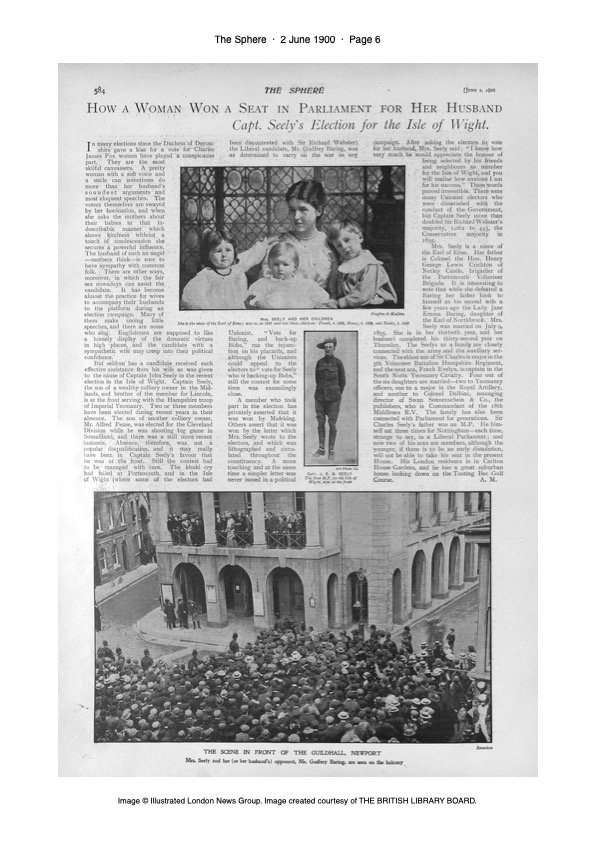
Extract from The Sphere, June 2 1900 (Image source: With kind permission of Mary Evans Picture Library)
We hear the voice of a young wife and mother appealing to the electorate in support of her absent husband and it is understandable that her words struck a chord with the local electorate. The outcome was a resounding majority for Jack which was double that of the previous Conservative victor in the election of 1895. Emily can be seen standing proudly on the balcony of Newport Town Hall as the results were announced to the assembled crowd in the local newspaper clipping (see image).
After Jack’s return the couple continued to live at Berwick Lodge until 1905. Jack’s political career took off and he was to achieve high office in government. In 1904, he wrote a letter to his lifelong friend, Winston Churchill, with an address label of Berwick Lodge which is now in the Churchill Archive, Churchill College, Cambridge. The letter shows the bond of friendship between the two men and their political careers shared common ground, with Jack crossing the floor of the House, with Churchill, to join the opposition party. Sadly, Emily died in 1913 with the arrival of their seventh child, following complications with the birth.
On the other side of the Atlantic, in 1922, another young wife was also making waves in the political arena.
Constance’s story: “A rising society politician” (The Houston Chronicle, 26 March 1922)
In 1898, a young boy stayed at Berwick Lodge with his parents and grandfather for the summer season in Ryde. His name was Grafton Winthrop Minot and his family were wealthy Bostonians whose fortune had originally been made in the Ice Trade industry. Grafton stood patiently beside his beautiful mother, Honora, whilst their portrait was painted in Berwick Lodge’s lounge by the portraitist, Philip De László. When he grew up, Grafton became an international diplomat and he married Constance Lodge Gardner, granddaughter of Senator, Henry Lodge Cabot, and daughter of Congressman, Augustus Peabody Gardner. The couple’s romance was documented in newspapers of the day: “The dark beauty of Constance Gardner first flashed upon Minot, a favourite in diplomatic circles, in England where she was assisting her father in making arrangements for repatriation of Americans caught in the maelstrom of the world war. Minot was on a visit from Berlin where he was performing similar services. He followed her to America soon after she returned, with the wooing and a wedding the result” (The Washington Times, 22 November 1922, page 2).
Constance was born into a family steeped in politics and, despite the fact that women had only recently gained suffrage, she quickly stepped into the political limelight herself. She soon attracted attention, initially for her skills as a hostess for political society dinners, and subsequently with her speeches at Republican party gatherings. The Washington Times of 12 August 1922 announced that: “She is one of the smartest, cleverest and most generally attractive young matrons in the Capital….” and The New York Herald observed that she spoke “forcefully and logically” on political matters although it could not resist ascribing her political skills to her grandfather and no less than four previous generations of political forebears. In fact, Constance’s success also reflected her efforts to learn the political craft. She had matriculated from a Washington school of political economy and civil government and she took a ‘long and arduous’ course in public speaking. According to The Washington Evening Star: “She is rarely absent from either Senate or House gallery when a notable speech has been announced and, perhaps with the sole exception of Mrs Nicholas Longworth, she reads the Congressional Record more regularly and with more consuming interest than any woman in Washington. It is always on her library table and with every indication of having been well read and marked” (The Washington Evening Star, 19 November 1922, page 54). Clearly, Constance had invested considerable time and interest in achieving her political ambitions. In 1921, she spoke at The Roosevelt Club dinner in honour of her father, Congressman Augustus Peabody Gardner, and set out her stall: “I am very much gratified and greatly honoured at having been asked to speak here this evening. I am a comparative newcomer in politics, that is to say, I have only been sailing a little while under my own flag, though I have been an interested observer for a good many years” (The Roosevelt Club (1921) Reception and Dinner in Honour of the 59th birthday of Augustus Peabody Gardner: A Pioneer for Preparedness. Hotel Westminster, Boston, November 5 1921: page 29). Later that evening, Constance went on to make an impassioned case for women taking the initiative in American politics, emphasising the new perspectives that she felt they could bring into political thinking:
One of the great factors in maintaining our high stand, must, and will be, the women of the United States. Women undoubtedly bring a fresh inspiration and a new element of clean, unprejudiced thinking in the politics of our country. Their help in the solution of national problems will, I believe, prove invaluable, but we women cannot afford to ignore the lessons of history or to eliminate from our minds the principles of political economy. If we are to use the privilege of suffrage successfully, we must not overlook the practical side of national and international relationships. (The Roosevelt Club (1921) Reception and Dinner in Honour of the 59th birthday of Augustus Peabody Gardner: A Pioneer for Preparedness. Hotel Westminster, Boston, November 5 1921: page 29).
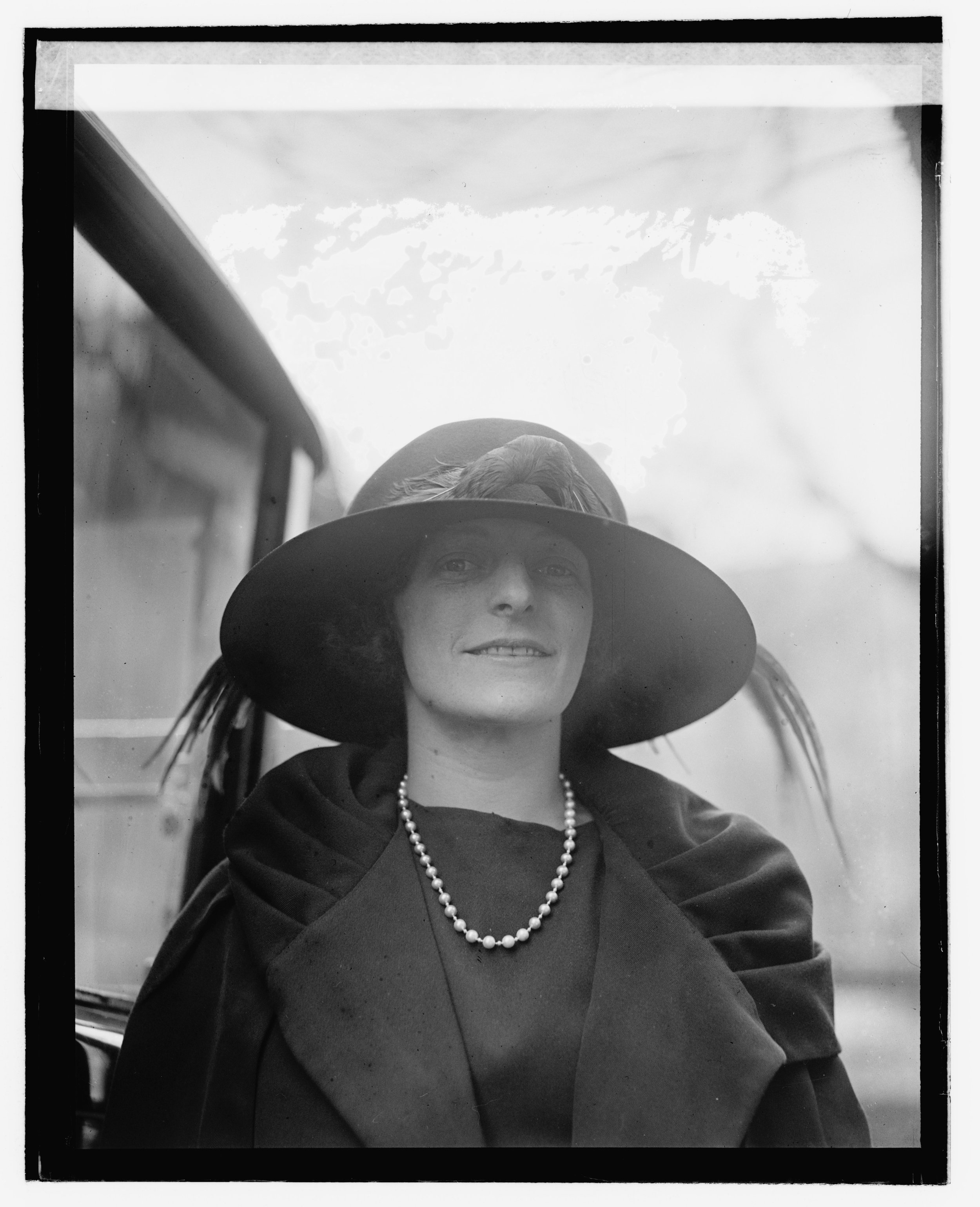
Constance Grafton Minot (Image source: Wikimedia Commons)
Sadly, Constance was not to go on to a career in politics though, despite her talent and political education. Her first marriage ended in divorce and she re-married twice at a time when such domestic upheavals were frowned upon in polite society and, moreover, in political circles. It seems that her promising start in politics gave way to the obstacles associated with women’s domestic lives and with the vagaries of social mores.
In the space of two decades, from 1900 to the 1920s, women were just beginning to step out from the margins and head tentatively towards the active centre of politics. Where once they had only been permitted “soft cooing” in their husbands’ campaigns, gradually women’s voices rose and strengthened. Eventually they were to be heard, amplified over and above the noise and mayhem of a world war and unprecedented social change. Decades later, the UK elected its first female Prime Minister, Margaret Thatcher, in 1979, and she remained in that office until 1990. Women have also held high political offices in the USA although to date it has yet to elect a female President. When we look back to the lives of Emily and Constance, we can see how they set small ripples of change in motion for women to take a more active role in democratic life but we also see familiar challenges still facing women in politics today.Evidently there is further to go along this road before we finally achieve equality in our systems of democratic representation.
